Standard 11th Computer Science  Course

Standard 11th Computer Science Course

  • Product Code: Standard 11th Computer Science Course
  • Availability: In Stock
  • ₹19,999.00

  • Ex Tax: ₹19,999.00

Qty
CBSE • Class XI

Computer Science Course Contents

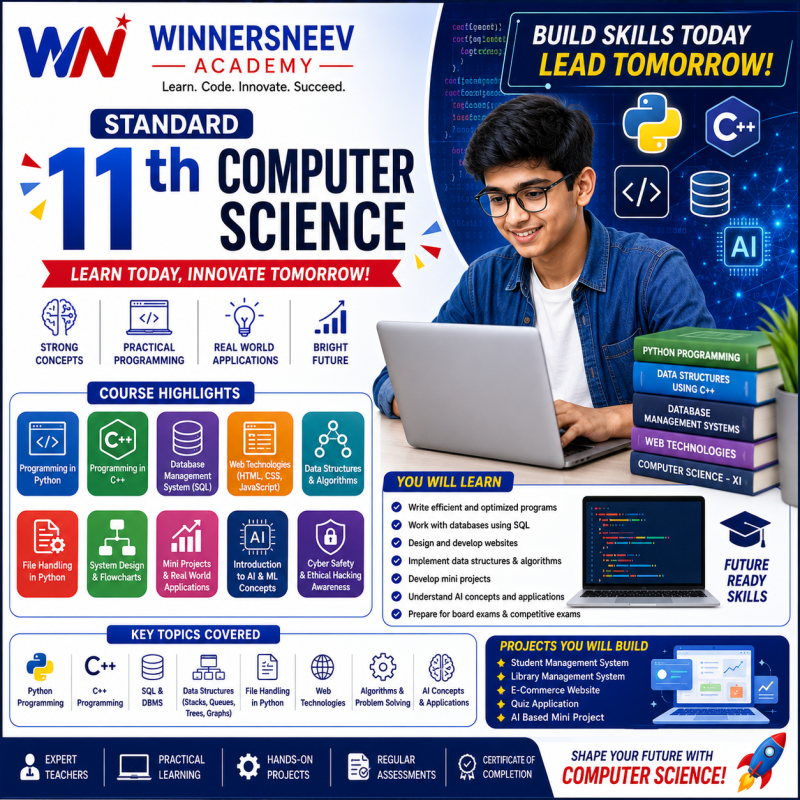
A structured 3-month learning program covering computer systems, number systems, Boolean logic, Python programming, data structures, databases, SQL, computer networks, cybersecurity and artificial intelligence awareness.

3 Months Structured Learning Program
20 Course Modules
Python Programming & Practical Lab

Explore the Course Modules

Learn fundamental concepts step by step, from computer organisation to practical Python programming and emerging technologies.

🖥️
Module 01

Computer Systems & Organisation

  • Introduction to Computer Science
  • Computer system overview
  • Hardware and software
  • CPU and its components
  • Memory and storage
  • Input and output devices
  • System and application software
  • Operating systems and their types
  • Computer architecture basics
🔢
Module 02

Data Representation & Number Systems

  • Decimal, binary, octal and hexadecimal
  • Conversion between number systems
  • Binary arithmetic
  • Character encoding
  • ASCII and Unicode
  • Data representation in computers
🔌
Module 03

Boolean Logic

  • Introduction to Boolean algebra
  • Boolean variables and expressions
  • AND, OR and NOT gates
  • NAND and NOR gates
  • XOR and XNOR gates
  • Truth tables and logic circuits
  • Applications of logic gates
🧩
Module 04

Introduction to Problem Solving

  • Computational thinking
  • Problem identification and decomposition
  • Algorithms and pseudocode
  • Flowcharts
  • Algorithm design
  • Testing and debugging
  • Efficiency and optimization basics
🐍
Module 05

Python Programming

  • Introduction to Python and its syntax
  • Python interpreter
  • Variables, constants and keywords
  • Identifiers and data types
  • Type conversion
  • Input and output statements
  • Comments, errors and debugging
➗
Module 06

Python Operators & Expressions

  • Arithmetic operators
  • Relational operators
  • Logical operators
  • Assignment operators
  • Membership and identity operators
  • Operator precedence
  • Expressions in Python
🔀
Module 07

Conditional Statements

  • if statements
  • if-else statements
  • if-elif-else statements
  • Nested conditions
  • Multiple conditions
  • Practical problem-solving programs
🔁
Module 08

Iterative Statements

  • Introduction to loops
  • for and while loops
  • range() function
  • Nested loops
  • break and continue
  • Pattern-printing programs
  • Mathematical problems using loops
🔤
Module 09

Python Strings

  • Creating strings
  • Indexing and slicing
  • String operators
  • Traversing strings
  • String methods
  • Searching and counting
  • String-based programs
📋
Module 10

Python Lists

  • Creating lists
  • List indexing and slicing
  • Updating list elements
  • Adding and removing elements
  • List methods and traversal
  • Searching and sorting
  • Nested lists
📦
Module 11

Tuples

  • Creating tuples
  • Tuple indexing and slicing
  • Tuple operations and methods
  • Lists vs tuples
  • Practical applications
📚
Module 12

Python Dictionaries

  • Dictionary concepts
  • Keys and values
  • Creating and accessing dictionaries
  • Adding and updating data
  • Removing elements
  • Dictionary methods and traversal
  • Practical dictionary programs
⚙️
Module 13

Python Functions

  • Need for functions
  • Built-in and user-defined functions
  • Defining functions
  • Parameters and arguments
  • Return values
  • Scope of variables
  • Modular programming
  • Function-based problem solving
🧱
Module 14

Introduction to Data Structures

  • What is a data structure?
  • Primitive and non-primitive data
  • Lists as data structures
  • Stack and queue concepts
  • Searching and sorting
  • Real-world applications
🗄️
Module 15

Database Concepts

  • Introduction to databases
  • Data vs information
  • Database management systems
  • Tables, records and fields
  • Primary keys
  • Relational databases
  • Introduction to SQL and database operations
🧮
Module 16

SQL Fundamentals

  • CREATE and INSERT
  • SELECT, UPDATE and DELETE
  • WHERE clause
  • ORDER BY
  • Basic filtering
  • Aggregate functions
  • Practical SQL exercises
🌐
Module 17

Computer Networks

  • Introduction to networks
  • Network components
  • LAN, MAN and WAN
  • Network topologies and devices
  • Internet and World Wide Web
  • IP addresses and domain names
  • Network protocols
  • Wired and wireless networks
  • Network security basics
🔐
Module 18

Cybersecurity & Digital Ethics

  • Cybersecurity fundamentals
  • Malware and phishing
  • Password security and data privacy
  • Identity protection
  • Social engineering awareness
  • Cybercrime awareness
  • Copyright, plagiarism and open-source software
  • Digital citizenship and ethical technology use
🤖
Module 19

Artificial Intelligence Awareness

  • Introduction to AI
  • AI vs traditional programming
  • Machine learning basics
  • Data and AI
  • Computer vision
  • Natural language processing
  • Generative AI and applications
  • AI ethics, bias and fairness
  • Responsible AI use

💻 Module 20: Practical Programming Lab

Apply classroom concepts by writing, testing and debugging Python programs. Practice progressively from basic calculations to functions and data structures.

✓ Number calculator
✓ Simple and compound interest
✓ Largest of three numbers
✓ Even/odd checker
✓ Prime number checker
✓ Factorial program
✓ Fibonacci series
✓ Armstrong number
✓ Palindrome program
✓ Pattern printing
✓ String operations
✓ List operations
✓ Tuple programs
✓ Dictionary programs
✓ Searching programs
✓ Sorting programs
✓ Function-based applications

What Will You Learn?

Develop a foundation in computer science and programming through conceptual learning, logical thinking and practical exercises.

✓ Understand computer systems and number representation.
✓ Design algorithms and solve problems logically.
✓ Write Python programs using conditions and loops.
✓ Work with strings, lists, tuples and dictionaries.
✓ Understand functions and basic data structures.
✓ Learn database concepts and write SQL queries.
✓ Understand computer networks and online safety.
✓ Explore AI concepts and responsible digital practices.